by Aubrey Taylor
The Beginning
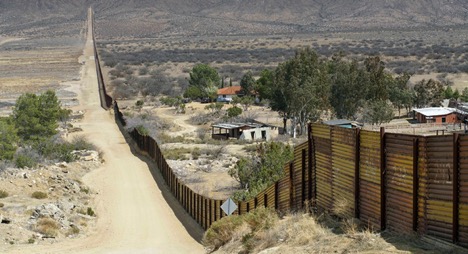
(Image of the current Mexican-U.S. Border)
The U.S.-Mexican border that we are familiar with today is nearly 2,000 miles long, bordering along the south of California, Arizona, New Mexico, and Texas. However, this current area wasn’t always the border. The territory of Mexico once included most of Western U.S. and was owned by Spain (About the Border). So, how did present-day Mexico come to be? Initially, it started in the year 1492, with a man name Christopher Columbus.
People are well aware of the great discovery of the Americas in 1492. Ever since this land was exposed to the Eastern World, it was a race to claim the land and its significant desired goods. One of the more noteworthy countries to conquer the Americas was Spain. The commencement of Spanish colonization began with the conquering of Spaniard Hernán Cortés in 1519. Having had formed many allies, Cortés attacked the indigenous civilizations and conquered the Aztecs in May 1521. Following the Spanish victory, Cortés colonized and named the area Nueva España, translated as New Spain. By 1574, Spain had control over a vast percentage of the Aztec empire and enslaved the native people. Skip a couple centuries to the year 1808, and success began to drop. Napoleón Bonaparte invaded Spain which compromised the political and economic structure. This action weakened Spain’s grip on Nueva España.
September 16, 1810, a call of rebellion was disseminated by Miguel Hidalgo y Costilla. This call was answered when, Vicentte Guerrero and Agustín de Itúrbide drafted a Mexican constitution allowing for Mexico to gain independence from Spain in 1821. Later in 1822, Itúrbide professed himself as emperor. Just one year later, Itúrbide was overthrown and Antonio López de Santa Anna created a new constitution and established a federal Mexican republic consisting of 19 states and four territories. Between the years 1823-1836, Santa Anna functioned as president and was later defeated by American forces during the Mexican-American War (History of Mexico).
During the year 1844, James K. Polk won the U.S. Presidential election with the pledge to fulfill America’s “Manifest Destiny”. The “manifest destiny” began with the seizing of Texas in 1845, fading Mexico’s relations with the United States. After the Mexican refusal of $30 million dollars from the U.S. for California and New Mexico, Polk sent 4,000 troops to Texas, and shortly thereafter a Mexican attack on these troops triggered the United States to declare war on Mexico. April 25, 1846 marked the start of the Mexican-American War. Eventually, after many grim battles, the Mexican capital was apprehended in September 1847 by the United States(About the Border).
The Mexican-American War officially ended February 2, 1848 with the signing of the Treaty of Guadalupe Hidalgo. This treaty transferred 525,000 square miles (approximately 55 percent) of Mexico’s territory to the United States. This territory included land that is present-day New Mexico, Arizona, California, and land north of those states. Under the Treaty of Guadalupe Hidalgo Mexico also formally gave up claims of Texas and recognized the Rio Grande as America’s southern boundary, which happens to be nearly the same as the present-day southern U.S. border (Treaty of Guadalupe Hidalgoand U.S.-Mexico Border).
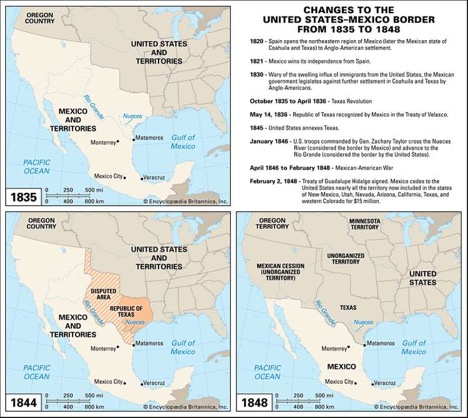
In an attempt to resolve conflicts that lingered after the Mexican-American War, four years later on June 8, 1854, the Gadsden Purchase was finalized and signed. This purchase resulted in the United States paying Mexico $10 million for a 29,670 square mile portion of Mexican territory that later became the southern part of Arizona and New Mexico. Despite its failure to solve tension and border attacks, it did, however, create the current Mexico-U.S. border (Gadsden Purchase).
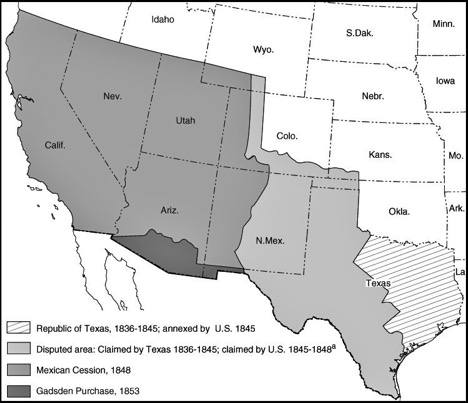
(Treaty)
The Mexican-American border was a three-century border in the making. From the beginning of Spanish conquest in the Americas, to the Independence of Mexico, to the Mexican-American War, to establishing the present-day border, citizens along the border have had an interesting history of success, hardships, and loss. Nevertheless, this history is what made the border and these countries and these peoples what they are today.
Works Cited
Klein, C. (2018, April 17). Everything You Need to Know About the Mexico-United States Border. Retrieved from https://www.history.com/news/everything-you-need-to-know-about-the-mexico-united-states-border
Editors, H. (2009, November 09). History of Mexico. Retrieved from https://www.history.com/topics/mexico/history-of-mexico
Editors, H. (2009, November 09). Treaty of Guadalupe Hidalgo. Retrieved from https://www.history.com/topics/mexican-american-war/treaty-of-guadalupe-hidalgo
Little, B. (2018, April 09). The Violent History of the U.S.-Mexico Border. Retrieved from https://www.history.com/news/mexico-border-wall-military-facts
Wallenfeldt, J. (n.d.). How the Border Between the United States and Mexico Was Established. Retrieved from https://www.britannica.com/story/how-the-border-between-the-united-states-and-mexico-was-established
Office of the Historian. (n.d.). Gadsden Purchase, 1853-1854. Retrieved from https://history.state.gov/milestones/1830-1860/gadsden-purchase
Oliver, P. (2017, July 12). What the Treaty of Guadalupe Hidalgo Actually Says. Retrieved from https://www.ssc.wisc.edu/soc/racepoliticsjustice/2017/07/12/what-the-treaty-of-guadalupe-actually-says/

 Borderlands
I am really glad that you wrote about the history of the United States and Mexican border. I was really interested in how Mexico became its own country after the European’s came and conquered North and South America.
Do you know how much the United States paid Mexico for the rest of the states, for example, Califonia, Nevada, Texas, and Utah? It is amazing that the U.S. paid Mexico $10 million for Southern Arizona and New Mexico, but Mexico still suffers from poverty. What do you think that Mexico did with the money they received from selling land to the U.S.?
LikeLike
Those are great questions Hayley. I too would like to know the answer to that.
LikeLiked by 1 person
This was very informative. I didn’t realize how much I DIDN’T know until I read through your post. I also liked how you incorporated maps and graphs to help illustrate the information you provided. It was also interesting to think that the U.S./Mexico war ended in 1848. From my perspective it doesn’t feel like the war has ended. Great job!
LikeLike
Wow, you cant tell that you really did your research. You did a great job of taking so much information and explaining it so simply that anyone could follow along and understand it. I learned so much from this post that I had never even heard about prior to reading it.
LikeLiked by 1 person
I really enjoyed studying your paper! The history of the border between Mexico and the United States gave me the idea to compare it with other countries and how they are or were enacting border regulations and immigration laws.
I used your paper for a really good base on my own! Nice job Aubrey!
LikeLiked by 1 person