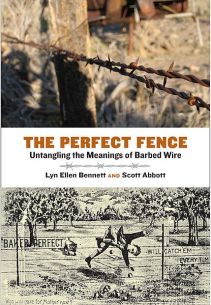
A section from Lyn Bennett’s and my book A Perfect Fence:
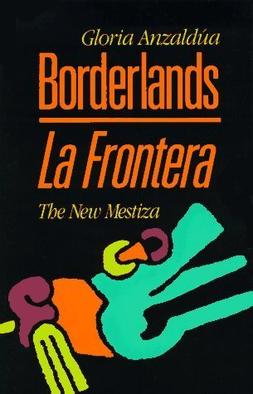
In her influential 1987 meditation on Borderlands/La Frontera, Gloria Anzaldúa explores ideas of identity in an extraordinary “in-between space” or interstice. She defines herself as the new mestiza, a creature of the dangerous borderlands between the United States and Mexico. Between genres (poetry, essay, history, memoir), between languages (English and various forms of Spanish), between cultures (Indian, Mexican, white), Anzaldúa chooses barbed wire as a metaphor for where and how she lives in the borderlands.
I press my hand to the steel curtain –
chainlink fence crowned with rolled barbed wire—
rippling from the sea where Tijuana touches San Diego
unrolling over mountains
and plains
and deserts,
this “Tortilla Curtain” turning into el rio Grande
flowing down to the flatlands
of the Magic Valley of South Texas
its mouth emptying into the Gulf.
1,950 mile-long open wound
dividing a pueblo, a culture,
running down the length of my body,
staking fence rods in my flesh,
splits me splits me
me raja me raja
This is my home
this thin edge of
barbwire.
The barbed wire that stretches from the Pacific Ocean to the Gulf of Mexico is a tool of oppression, rusted witness to the years since the U.S. took over vast stretches of Mexico at the end of the Mexican-American War.The idea of the thin edge of barbed wire that stakes and splits flesh as home is unthinkable. Anzaldúa thinks it, teases out the implications, embraces the fence that splits her. She moves from poetry to prose to think about border identities:
The U.S.-Mexican border es una herida abiertawhere the Third World grates against the first and bleeds. And before a scab forms it hemorrhages again, the lifeblood of two worlds merging to form a third country—a border culture. Borders are set up to define the places that are safe and unsafe, to distinguish usfrom them. A border is a dividing line, a narrow strip along a steep edge. A borderland is a vague and undetermined place created by the emotional residue of an unnatural boundary. It is in a constant state of transition. The prohibited and forbidden are its inhabitants. Los atravesadoslive here: the squint-eyed, the perverse, the queer, the troublesome, the mongrel, the mulato, the half-breed, the half dead; in short, those who cross over, pass over, or go through the confines of the “normal.”
If borders are set up to divide us from them, and if she refuses that separation, then Anzaldúa must inhabit the border. She must claim the very machinery of violence that establishes the border. If the barbed wire is her home, she becomes dangerous rather than endangered. This new myth is hybrid, powerful, and affirming. The barbed wire has split me? Then I am the barbed wire fence.
But (and the poem approaches its end with a “but”) fences that rip a person and a pueblo apart ought themselves to be blown down; and for this the old myth is ready with the goddess of the ocean who punishes the arrogance of the white man who has strung the barbed wire.
But the skin of the earth is seamless.
The sea cannot be fenced,
El mardoes not stop at borders.
To show the white man what she thought of his
Arrogance,
Yemayá blew that wire fence down.
Barbed wire enclosed the territories of Native migration and shared resources just as surely as it enclosed the free range. Barbed wire takes its place in Native American and mestizatexts as an actual and metaphorical definer and destroyer of cultures, separating us and them, enforcing boundaries through hegemonic stories, and, positively, establishing boundaries that invite courageous and creative hybrid responses.

 Borderlands
Your post references to the border being as a barbed wire fence, a divider, and implies other negative aspects about the border. I find these comparisons intriguing. I nearly only ever read about why the border is a negative aspect, but do you think there is anything positive about it? What good is it? If there isn’t any good in having it, like many poems, stories, and art implies, then why is it still there? Would it be better to not have any borders at all, including for the rest of the world? Do you think if the U.S. were to come and try to take the current country of Mexico just like they did during the Mexican-American War, that many of the people would freely give it up, just to be given the opportunity to take advantage of American opportunities and be a citizen?
LikeLike