by Aubrey Taylor
Art installations can be found all around the world. They are used to assert ideas about an area or culture, forcing people to think more openly about notions and concepts. Often, art installations will evoke thoughts and emotions in the viewer that change their perspective and force them to question what the meaning may be. Art, in general, has been used time and time again as a mean of questioning society and encouraging people to think/engage in new ways. As an artist myself, I know that artists tend to think of how our piece can impact others the most. Often the use of pre-existing objects or settings can create the maximum influence and evoke the greatest feelings and meanings. That is the purpose of art installations.
According to The Art Story,
“Installation art is generally used to describe artwork located in three-dimensional interior space as the word “install” means putting something inside of something else. It is often site-specific – designed to have a particular relationship with its spatial environment on an architectural, conceptual, or social level. It also creates a high level of intimacy between itself and the viewer as it exists not as a precious object to be merely looked at but as a presence within the overall context of its container whether that is a building, museum, or designated room” (The Art Story).
One of the most common settings for art installations is along the Mexican-United States border. A recent installation along this border was created by French artist JR in 2017. This particular art work was a combination of two pieces, “Kikito” and “Gigantic Picnic” (latinousa). Kikito is located along the border in Tecate, California and Tecate, Mexico. The piece itself is situated on the Mexican side of the border, but it can’t be viewed with its full optical effect from that side. David Bacon, California writer and photojournalist, states that, “Viewed from the U.S. side, Kikito becomes a giant black-and-white toddler, his chubby hands appearing to grip the top of the border wall as he looks over it, into the mysterious United States. He has a slight smile” (The Art of the Border).
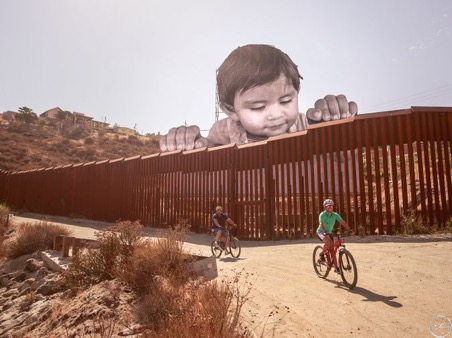
(JR in Tecate)
The image of a one-year old boy playfully peering over the border fence can evoke different emotions, thoughts, and meanings, but the perception is limited to the viewer themselves. According to The New York Times, in an interview with JR, he said, “I wonder, is this kid worrying about what will happen? What does he think? At one year old, you don’t see the frontier or which side is better.” He continues to explain that, “As an artist, I try to bring back perspective. For this little kid, there are no walls and borders”(New York Times).
On the last day of the Kikito installation, only a few feet away, JR launched another art installation called the “Gigantic Picnic”. The purpose was to be an international picnic organized on both sides of the fence, with hundreds of people sharing a meal together. The main art piece comprised of a photo of the eyes of a “Dreamer” turned into a large surface people could eat off of. It was essentially, a large table with one eye in Mexico and the other eye in the United States.
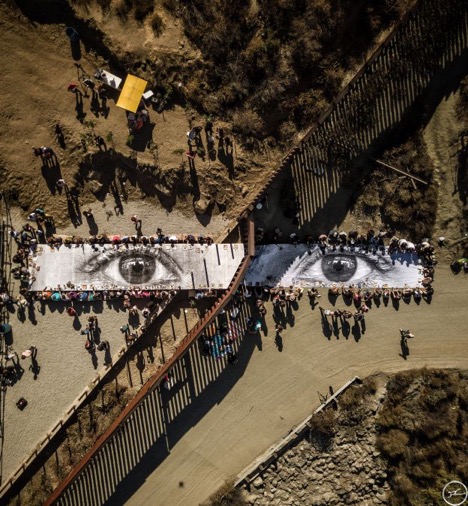
(Gigantic Picnic)
This site-specific project created a moment to be remembered. It allowed those in attendance to feel what JR had intended, peace and the tranquility of no walls and borders.
“The table goes through the wall, and the people eat the same food and drink the same water and listen to the same music,” JR says. “For a minute we were forgetting about it, passing salt and water and drinks as if there were no wall” (Time).
I find this specific art installation unique among the many others that have been revealed along this border due to the artist being French. As I researched other art installationsI noticed that the artists were predominately Mexican or from Mexican heritage. Many of these pieces along the Mexico-U.S. border have brought beauty, emotion, and complex ideas similar to the recent JR installations.
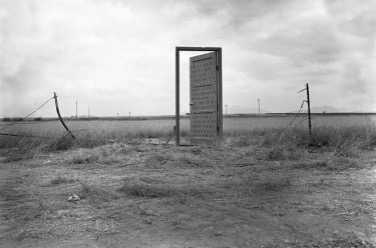
“Border Door” (1988), by Mexican descendant Richard Lou(Culture Trip), was a door that sat along the border in Otay Mesa, California. Lou’s wooden door was hinged to a metal frame holding 134 keys that hung from nails hammered into the Mexican side of the door. This sculpture, opening one way toward the United States, portrayed a gesture of migratory welcome (LATimes).
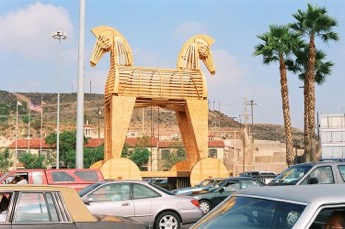
Nearly ten years later (1997) another installation was set up near the border, called “Toy An Horse” by Marcos Ramirez ERRE. This piece consisted of a 10 m high two headed transparent wooden horse. It was installed just above the border crossing between Mexico and the U.S. According to ERRE’s website, “Its transparency symbolizes the evident mutual exchange, or invasion. This piece intends to question, with its sole presence, the relationship between the two countries” (ERRE).
Another emotionally edifying piece was “Paseo de la Humanidad”, translated as “Parade of Humanity”. This masterwork was mounted in March 2004 on the west end of the border wall in Nogales, Sonora, Mexico. It was a collaboration between a University of Arizona Professor, Alfred Quiroz, and two Mexican artists, Alberto Morackis and Guadalupe Serrano. UA News wrote, “This piece consists of “figurative aluminum cutouts based on immigration crossing experiences and border ‘milagros’” (UANews). In more detail, this art installation depicted two groups of four migrants trying to cross the desert. One group, led by an ethnic costumed figure while carrying a baby, are moving north. The other group, heading south, are carrying symbols of the developed United States and a lone body. This body is to represent the hundreds of migrants that have died navigating the desert passageways leading to the U.S. (Culture Trip).
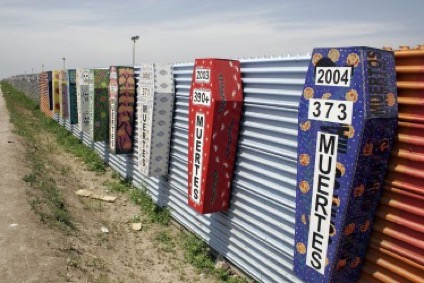
“Border Coffins” by Alberto Caro is an additional installation provoking the feelings of dismay for the reacquiring deaths surrounding the border. This piece acts as a memorial involving a series of colorful painted coffins on the Mexican side of the border in the Tijuana area. Each coffin represents a year displaying the number of migrants who died attempting to cross the border. Due to the U.S. governments launch of Operation Gatekeeper, migrants were forced to take more remote and dangerous routes, consequently, increasing the death toll (Culture Trip).
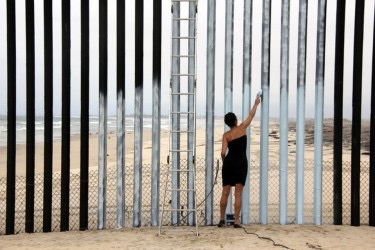
In the year 2011, artist Ana Teresa Fernandez, wearing a little black cocktail dress and black pumps, set a sizable ladder against the border wall along Tijuana, Mexico and San Diego, California. Using a spray gun, she painted the bars a pale powdery blue and titled it “Erasing the Border”. The project “situates the sensual/laboring female body in the specific context of the U.S.-Mexico border, a site where personal, national and gender histories intersect” …It is also presented to “remind us of the power of utopian visions, of dreams and the imagination” (ATF).
Art is an inspiration for people all over the world. It can challenge ideas, question society, conjure emotions, and change the world in positive ways. There are a wide variety of pieces that surround the Mexico-U.S. border, and in places beyond that. Similar to the installations presented, creativity, imagination and heart felt emotion can be seen. Yet, every experience is different for each individual. There are many different ways to interpret art, the same goes for these art installations. Despite what the artist intended, there is room for your own personal interpretation and understanding. However, if there is one thing similar of most, if not all, art, it is the dreams that come with it.
Works Cited
Installation Art Movement Overview. (n.d.). Retrieved from https://www.theartstory.org/movement-installation-art.htm
How Artists Can Shape Understanding of the U.S.-Mexico Border. (2018, January 18). Retrieved from https://latinousa.org/2018/01/18/artists-can-shape-understanding-u-s-mexico-border/
Bacon, D. (2017, October 30). The Art of the Border: Searching for Kikito. Retrieved from https://prospect.org/article/art-border-searching-kikito
JR in Tecate. (2017, September 12). Retrieved from https://www.jr-art.net/news/jr-in-tecate
Ryzik, M. (2017, September 07). JR’s Latest: A Child Caught Between the U.S.-Mexico Border. Retrieved from https://www.nytimes.com/2017/09/07/arts/design/jr-artist-mexico-border-wall.html
Gigantic picnic at the US-Mexico border fence. (2017, October 17). Retrieved from https://www.jr-art.net/news/gigantic-picnic-at-the-us-mexico-border-fence
Alter, C. (2017, October 12). A Picnic at the Border. Retrieved from http://time.com/4979252/lightbox-picnic-at-the-border/
Woodman, S. (2018, March 01). Meet the 5 Artists Redefining the US–Mexico Border. Retrieved from https://theculturetrip.com/north-america/mexico/articles/meet-the-5-artists-redefining-the-us-mexico-border/
Knight, C. (2018, May 4). ‘Border Door’ provided a poetic welcome to immigrants 30 years ago. An art show brings back its message. Retrieved from https://www.latimes.com/entertainment/arts/la-et-cm-soul-mining-vpam-20180504-htmlstory.html
Toy an-horse. (n.d.). Retrieved from http://marcosramirezerre.com/toy-an-horse/
Holslin, J. (2013, July 16). Borrando la Frontera. Retrieved from http://anateresafernandez.com/borrando-la-barda-tijuana-mexico/
Gonzalez, J. (2004, March 4). Art Professor’s ‘Parade of Humanity’ to Be Installed in Nogales, Mex. Retrieved from https://uanews.arizona.edu/story/art-professors-parade-humanity-be-installed-nogales-mex
 Borderlands